Your brakes rarely fail without giving you clues first. A squeak, vibration, soft pedal, or warning light may seem manageable when you are only driving a few miles across Tempe. But small brake problems can become safety risks, and more expensive repairs, if you wait too long.
Tempe drivers put extra stress on their braking systems. Stop-and-go traffic on Rural Road, Broadway Road, Apache Boulevard, and around the Mill Avenue corridor means frequent braking. Summer heat raises component temperatures, while monsoon dust and road debris can contribute to noise and uneven wear. Even in early October, those conditions can leave brake problems that continue throughout the year.
Watch for these five warning signs, and arrange a professional inspection before a minor repair turns into a major one.

1. Squealing or squeaking when you brake
A brief squeak after rain, a car wash, or a vehicle sitting overnight may come from moisture or light surface rust. That noise should usually disappear after a few normal stops.
Persistent squealing is different. Many brake pads have a small metal wear indicator designed to make a high-pitched sound when the friction material is getting thin. The sound is your early warning that the pads may be approaching the end of their service life.
Dust, glazing, or uneven pad wear can also cause squeaking. Glazing happens when brake material becomes hardened or shiny from excessive heat, reducing smooth contact between the pad and rotor.
Do not assume every squeak means you need the most expensive brake job available. A proper inspection should measure pad thickness, examine the rotor surface, and check whether dust or uneven wear is the cause. Sometimes the repair is limited to brake pads. Waiting too long, however, can allow the pad backing plate to damage the rotor.
Schedule brake repair in Tempe if the squeal continues, becomes louder, or comes with longer stopping distances.
2. Grinding or scraping means metal may be contacting metal
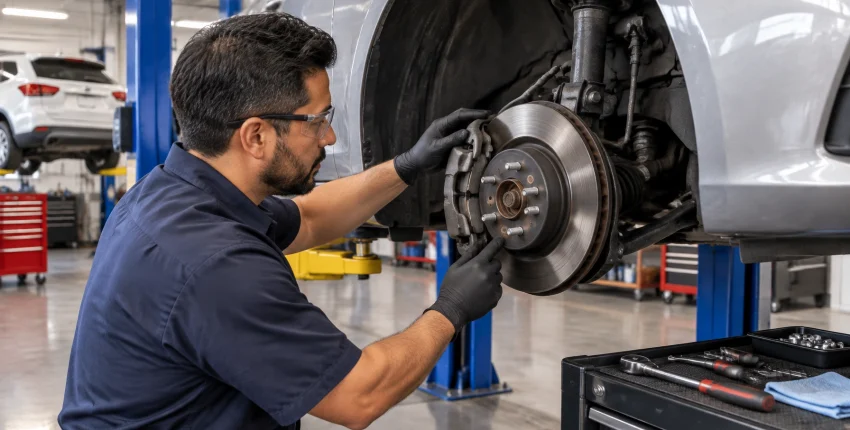
Grinding is more serious than squeaking. A harsh grinding, scraping, or growling sound when you press the brake pedal often means the friction material has worn away and the metal backing plate is contacting the rotor.
At this stage, the brake pad is no longer protecting the rotor. Continued driving can score or severely damage the rotor, overheat the caliper, and reduce braking performance. What might have been a relatively straightforward pad replacement can become a repair involving pads, rotors, caliper hardware, and possibly a damaged caliper.
Treat grinding as an urgent warning. Avoid unnecessary driving, especially on busy roads or at freeway speeds. If the pedal feels abnormal, the vehicle takes longer to stop, or the sound is severe, arrange for the vehicle to be towed rather than risking the drive to a shop.
An honest inspection should show you the condition of the components and explain what must be repaired now versus what can safely be monitored later.
3. A soft, spongy, or sinking brake pedal
Your brake pedal should feel firm and predictable. If it feels soft, spongy, or unusually low, do not write it off as normal wear.
A soft pedal usually points to a hydraulic problem rather than simply worn brake pads. Possible causes include air in the brake lines, a brake fluid leak, contaminated fluid, a failing master cylinder, or a problem with a brake hose or caliper. Brake fluid transfers the force from your pedal to the brakes at each wheel. When air or moisture enters the system, or fluid escapes, the pedal may travel farther before the vehicle slows.
A pedal that slowly sinks while you hold pressure is especially concerning. A sudden change in pedal feel can mean the braking system is losing hydraulic pressure.
Check the fluid level only if you can do so safely, but do not treat adding fluid as a complete repair. The cause of the fluid loss must be found. If the pedal is severely soft, sinks close to the floor, or braking performance has dropped, stop driving and request professional help.
Brake fluid service may be appropriate, but a responsible technician should first check for leaks, inspect the lines and calipers, and test the complete system.
4. The vehicle pulls to one side during braking
Does your car drift left or right when you brake? Pulling is a sign that the braking force is not balanced between the wheels.
A sticking caliper is one possible cause. The caliper clamps the brake pads against the rotor. If it does not apply or release properly, one wheel may brake harder than the other. A sticking caliper can also create heat, uneven pad wear, a burning smell, or a wheel that feels unusually hot after driving.
Other causes include a restricted brake hose, contaminated brake material, unevenly worn pads, or a problem with the suspension or tire. That is why replacing parts without diagnosing the symptom can waste money and fail to correct the real issue.
Pulling is particularly risky during an emergency stop, on wet pavement, or when changing lanes in busy Tempe traffic. Have the brakes and related steering and suspension components inspected promptly.
A shop should compare pad wear from side to side, check caliper movement and slide pins, inspect hoses, and verify that the tires are not contributing to the pull.
5. Vibration, shudder, or a brake warning light
A pulsing brake pedal or vibration through the steering wheel often points to a rotor problem. Rotors can develop uneven thickness, hot spots, scoring, or deposits from the brake pads. Drivers commonly describe the sensation as a shudder when slowing from higher speeds.
Heavy stop-and-go driving and repeated high temperatures can contribute to rotor problems. A rotor does not always need replacement, but it must be measured against the manufacturer’s specifications. Resurfacing may be possible in some cases; replacement is the safer option when the rotor is too thin, badly scored, or damaged.
Do not ignore a brake warning light, either. Depending on the vehicle, it may indicate low brake fluid, a parking brake that is still engaged, worn pads with an electronic sensor, or another braking system fault. On some vehicles, an anti-lock brake warning may appear separately from the red brake warning light.
If the light appears with grinding, a soft pedal, pulling, vibration, or reduced stopping power, treat the situation as urgent. Even if the vehicle seems to stop normally, the warning light deserves a professional diagnosis.
What Tempe drivers should know about EV brakes
Electric vehicles use regenerative braking to slow the vehicle and return some energy to the battery. This can reduce friction brake use and help pads last longer. It does not eliminate the need for brake inspections or service.
EVs still have brake pads, rotors, calipers, brake fluid, lines, and related hardware. Because the friction brakes may be used less often, rotors can develop surface rust or corrosion, especially when a vehicle sits. Persistent squeaking, grinding, vibration, pulling, or a warning light still requires attention.
The same applies to hybrids, classic cars, domestic vehicles, and imported models. The right repair depends on the vehicle and the measured condition of its components, not on a generic package.
Get an honest brake inspection in Tempe
Do not approve brake work based on a vague noise or a guess. Ask for a clear inspection of pad thickness, rotor condition, caliper operation, brake fluid, hoses, and leaks. You should know which repair is necessary now, which maintenance can wait, and what may happen if you delay.
At Rob’s Auto Repair, an ASE Master Certified and BMW-Certified technician with more than 29 years of experience services all makes and models, including EVs and classic cars. We offer free estimates, honest transparent pricing, and same-day service whenever possible. Qualifying repairs are backed by a 2-year/24,000-mile warranty. You can also ask about $20 off service repairs over $100 and flexible financing through Snap Finance and Synchrony.
If your brakes are squeaking, grinding, pulling, vibrating, or showing a warning light, call Rob’s Auto Repair at (480) 210-1044 to book your free brake inspection in Tempe. Find out what your vehicle actually needs before a warning becomes a breakdown or a safety issue.